
A facilities management company photographs fifty handwritten time cards per site per day. Finance retypes them the following week. We built that job into a phone: the card's printed questions become the field list, the site manager scans the stack, and finance downloads the spreadsheet instead of building it. Documents should be processed when the worker creates or receives them, so data entry happens once, at the point of work, and the record is ready for finance immediately.
A facilities management company we worked with this year runs its payroll on paper time cards. The work happens on sites, the cards get filled in on sites, and the finance team that has to act on them sits in an office somewhere else. That distance turns simple data entry into delayed spreadsheets, missing-photo chases and late corrections after payroll has already run.
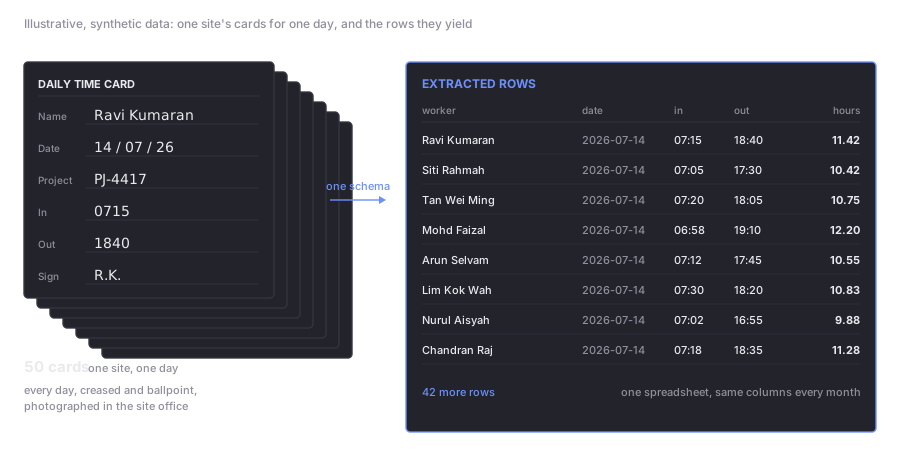
On one of those sites, the manager runs a crew of fifty cleaners. Each worker fills in a card at the end of the shift: name, date, time in, time out, break and trade. At six in the evening, the manager collects the stack and photographs each card. The photos sit in the camera roll until Friday, when the manager sends them as an email attachment. On Monday, someone in finance opens the email, types fifty rows into a spreadsheet, then opens the next site's email and does the same work again.
That is one site, one day, and the company measured the cleanup at five to six hours on its own timesheets. That time covers chasing managers who forgot to send the cards, asking for new photos when cards came out blurred, and fixing hours after payroll had already run.
That company is not unusual. Construction, engineering, facilities management and logistics teams create paper where the work happens, while finance and admin teams act on that paper later from the back office. A handful of people often supports several hundred workers across a dozen sites, so too many admin hours go into retyping what someone else already wrote by hand.
Document intelligence should move to the point of work because extraction is no longer the bottleneck. The harder problem is getting the document read, checked and sent to a person for approval while the job is still live.
SmartDoc Go brings time card processing to the site
We first built SmartDoc as a desktop product for finance and operations teams that process documents from their desks. SmartDoc Go brings the same document intelligence to the edge: the site, gate, warehouse or cab where the document is created. The worker or manager captures the paper there, and the back office receives a record it can check.
For the time card job, the manager opens SmartDoc Go and photographs a blank time card once. SmartDoc Go uses the printed questions on the card as the field list: worker name, date, time in, time out, break and trade. After that, the manager photographs the stack, each card comes back as fields in a table, and finance downloads the spreadsheet instead of building it by hand. The source photograph stays attached to every value, so finance can check the result before using it.
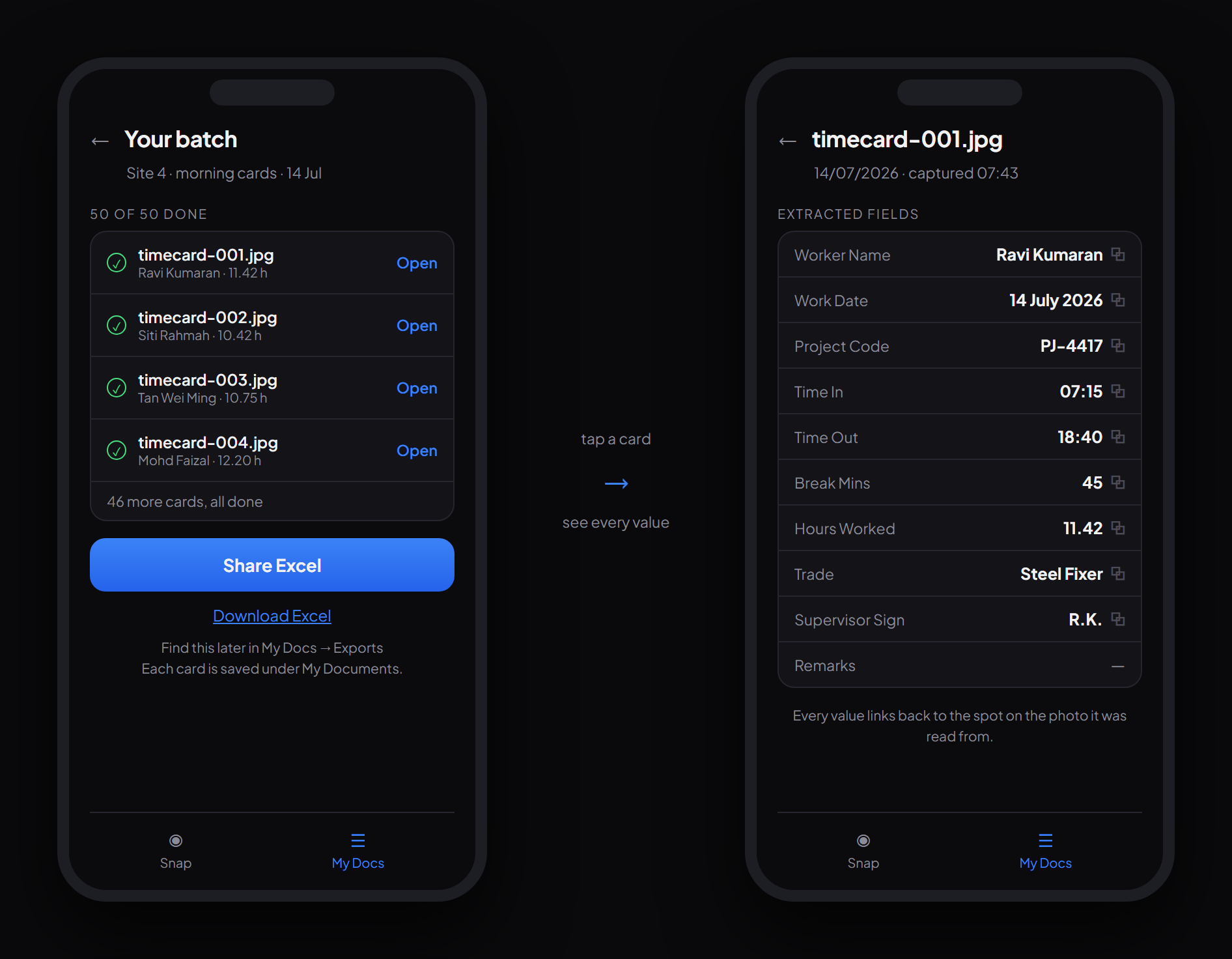
The manager's job barely changes because they were already photographing the cards. What changes is the handoff: the typing disappears, and finance receives a record it can review.
Extraction is no longer the bottleneck
For years, paper forms stayed near scanners because software could not read a creased card filled in with a ballpoint pen under a site light. SmartDoc now publishes 99+% document extraction accuracy on relevant benchmarks. The practical point is that handwriting is no longer the main reason these jobs fail.
The bigger problem is the trip from the site to the desk. A worker creates the document, a manager photographs it, the photo sits in a phone folder, the folder gets emailed at the end of the week, and someone at a desk opens the file and types. Each handoff adds delay, and that delay creates chasing, checking and rework.
Field accuracy matters because it feeds an approval decision. SmartDoc has to help the person responsible for the work decide whether to approve the record or flag it for review, and bringing document intelligence to the point of work means that decision happens while the work is still in front of someone, rather than days later when the paper reaches a desk.
The same problem appears in other jobs, and SmartDoc Go is equipped to solve them
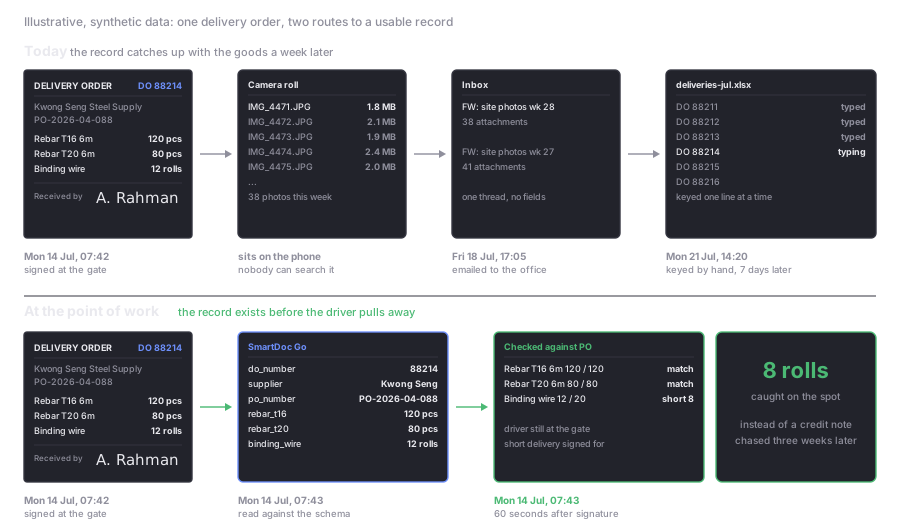
A delivery order checked at the gate. Today the check happens too late. Goods arrive, someone signs, the paper travels, and finance compares it to the purchase order weeks later when the invoice turns up. By then the driver has gone and the material is installed, so a short delivery becomes a negotiation instead of a correction. Photographing the delivery order at the gate and comparing it to the purchase order on the spot puts the check at the moment when a discrepancy is cheap to settle.
Invoices that arrive as paper. Supplier invoices still get handed over in hard copy. Without a photo at the receiving point, the only route into the finance system is a person and a keyboard. Reading the invoice where it arrives turns the header, line items and tax fields into table data, just like an emailed PDF.
What changes when document intelligence moves to the site
Admin teams stop spending hours chasing paper. The saving covers the keying, the chasing, the second photo when the first one came out blurred, and the month-end reconciliation caused by late or incomplete data.
Errors get caught while they are still cheap. A gate check runs while the driver is still there, so a mismatch can be settled before the material is installed. The same mismatch found three weeks later needs a credit note, a chase and someone's afternoon.
The company gets records it can use. The company chooses the field names once, and those names stay the same across every site and every month. A year of photos becomes a history of deliveries, hours and spend that finance can search and check. The same setup also captures supervisor know-how, because the checks an experienced supervisor runs in their head become fields and rules that remain after the person leaves.
The phone and desktop must share the same records
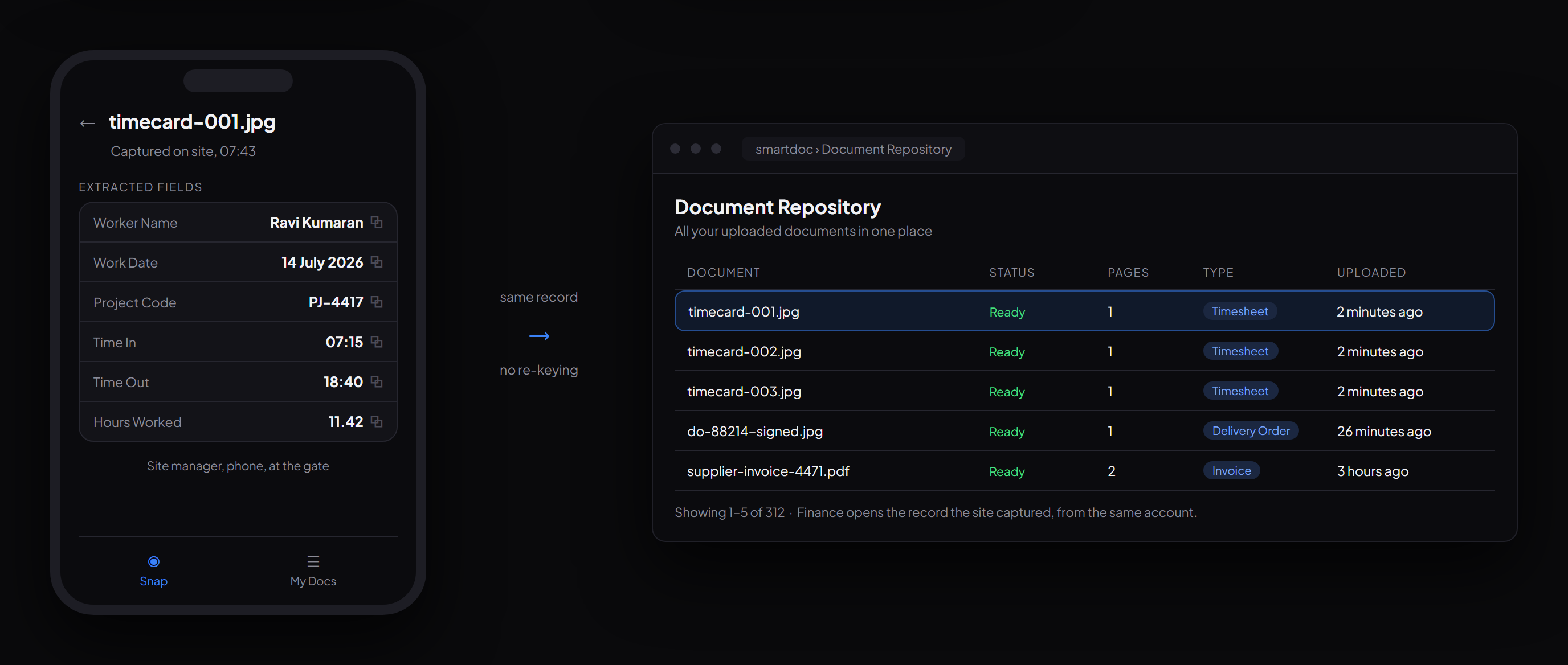
The phone and the desktop have to read from the same file store. What the site manager photographs is what finance opens, under the same account and the same permissions, with the source image attached to every value. Without that shared record, phone photos only create more files for finance to sort through.
Start with one document type
Document intelligence now belongs where the document is created. The point is not to remove the person from the process, but to move the read, check and approval step closer to the work, before errors become back-office cleanup.
If your team still photographs site paperwork and retypes it days later, start with one document type: a time card, delivery order, docket or paper invoice. We can configure SmartDoc Go around that form, test it on your real documents, and get the first working setup running in a day.