
A Singapore facilities management contractor has four weeks to prepare each government tender, and a large part of that time goes into reading the tender documents rather than deciding how to win. One tender we analysed came as 98 documents and 1,765 pages, with the requirements that decide compliance, scope and price scattered across them. Sorting every page first turns the pack into checklists, service frequencies and quantities the team can use straight away.
Analyzing tender packs consumes a large portion of the bid window
A bidder for government facilities management tenders wanted to automate tender reading so the team could spend more time on proposal preparation, stakeholder management and commercial structuring. These tenders can cover cleaning, pest control, landscaping, security and M&E maintenance across dozens of sites. A single contract can run for five years, with an option to extend for another five.
The bid team has four weeks from the day the pack drops to submit a proposal. In a typical bid, roughly one of those weeks goes into reading documents, consolidating quantities, checking service frequencies, building submission lists and making sure no mandatory gate has been missed. That leaves too little time for the work that should decide the bid: whether to bid, how to price risk, which subcontractors to use and where to sharpen the offer.
The stakes are high. On an illustrative SGD 200 million of annual tender value at a 15 percent win rate, three points of win rate is SGD 6 million of revenue.
Proposal failures usually start with price or compliance
Proposal failures usually fall into a few categories:
- A missed annex makes the bid non-compliant before evaluators reach the main submission.
- A quarterly assumption against a monthly servicing requirement prices the wrong scope.
- A failed credential requirement disqualifies the bid automatically.
- An incomplete quantity baseline leads to cost underestimation and margin leakage.
The failure starts when the team treats a tender pack as reading material. It is not just a stack of PDFs. It is a set of instructions, forms, tables, gates, frequencies, quantities and exceptions that have to be joined before the team can bid with confidence.
Case study: MSF facilities management tender pack
Public-sector tender work in Singapore starts on GeBIZ, where the listing carries the agency, the category, the closing date, the registration grade a bidder must hold and any corrigenda.
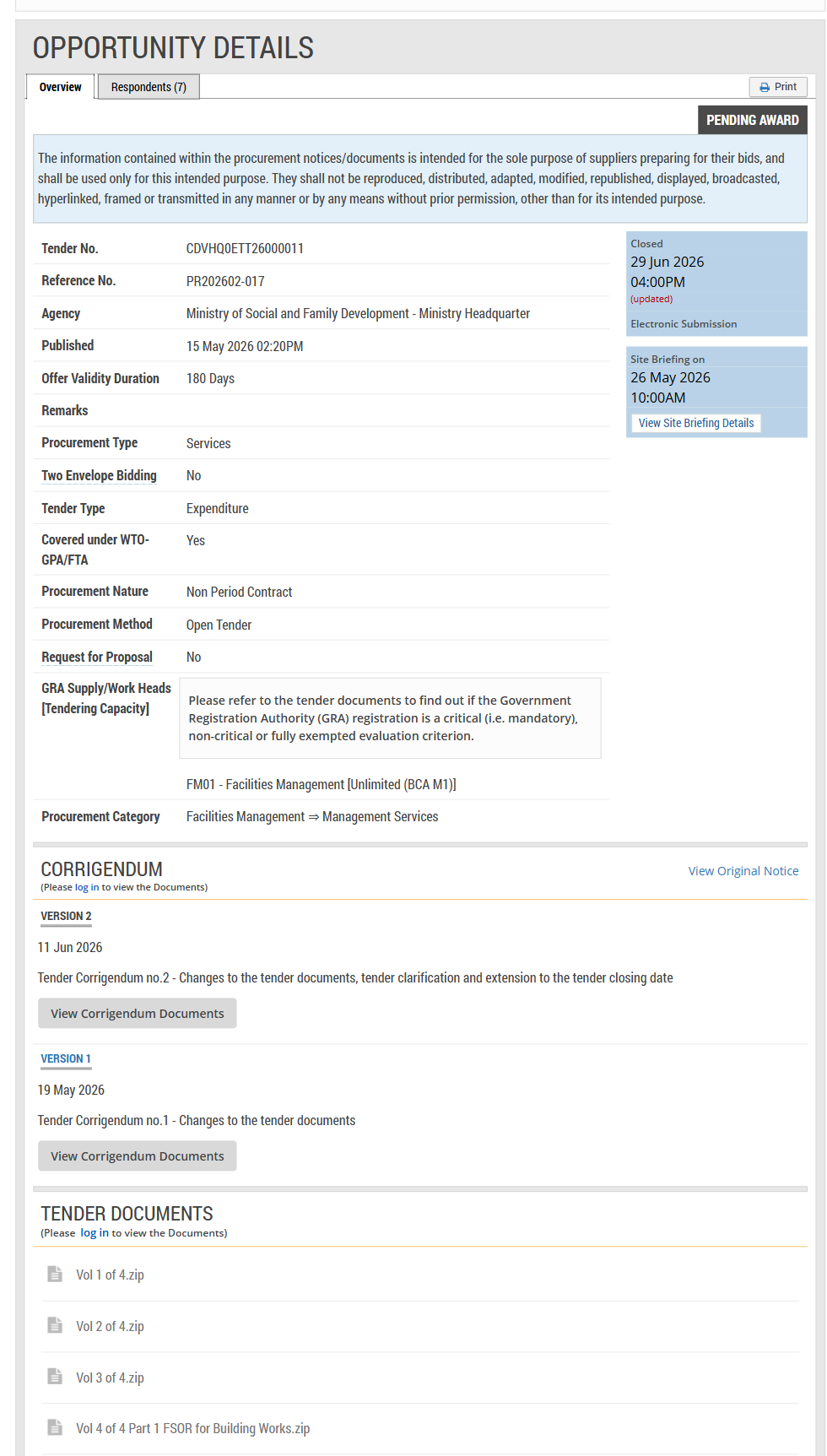
This case study follows a bidder analysing a Ministry of Social and Family Development integrated facilities management tender for social service facilities. The tender was published on 15 May 2026 for a five-year term with a five-year extension option. Two corrigenda followed. The second, issued on 11 June, changed the tender documents and moved the closing date from 15 to 29 June, so the pack the bidder started reading was not the pack it submitted against.
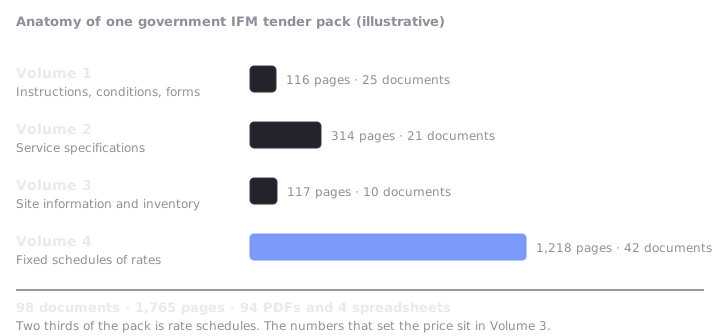
The pack had 98 documents and 1,765 pages across four volumes, delivered as seven zip archives: 94 PDFs and 4 spreadsheets. It covered 21 service lines, 17 facilities, 13 mandatory submissions and 13 evaluation criteria.
Those numbers matter because the important information was spread thinly across the pack. Two thirds of the page count was fixed schedules of rates. The parts that decided compliance, scope, quantity and margin sat in the remaining pages.
Scattered qualification requirements create tender compliance risk
The MSF IFM pack carried 14 pass/fail requirements. They were spread across the evaluation criteria and six service specifications, instead of being collected in one place.
Some requirements were company credentials: BCA FM01 Grade M1 registration, SIFMA company facilities management certification, an NEA Class 1 cleaning licence, an NEA vector control operator licence, and landscape company registration held for two cycles.
Some requirements were track record requirements. The tender asked for two integrated facilities management contracts, each above 40,000 square metres of gross floor area, completed within the last three years, and held as the facilities management contractor. Managing-agent work did not count.
The submission envelope added another failure path. Eight lettered annexes had to arrive completed. They covered the form of tender, official information undertaking, security deposit guarantee, key personnel CVs and organisation charts, sustainability records and proposed initiatives, and a progressive wage declaration. The team also had to complete the price schedules for both parts, submit the quality write-up, acknowledge every corrigendum and attend a compulsory site show-round whose pre-registration closed six days before the briefing. Two of those requirements are timing traps rather than content: the briefing registration deadline falls early enough to be missed by a team still reading, and each corrigendum has to be tracked and acknowledged after the pack has already been distributed internally.
One annex was a document submission listing. The agency included a completeness checklist because tenderers miss documents.
Service frequencies change the cost base
The second failure is quieter because the bid can appear valid while the cost assumptions are wrong.
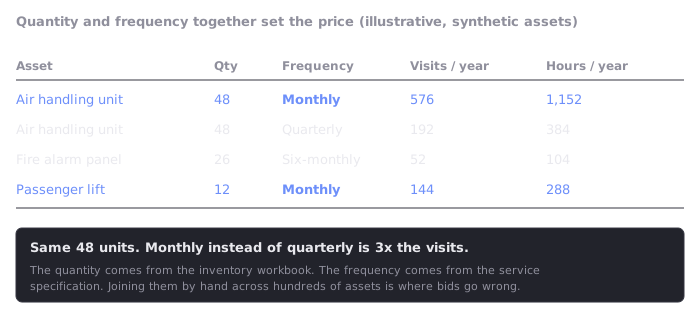
Maintenance scope often depends on service frequencies: monthly, quarterly, six-monthly, yearly. A wrong frequency changes site visits, man-hours, trade coverage and price. The bid may still pass compliance checks, but it carries the wrong cost base.
In the MSF pack, frequencies sat in service specifications while the related assets sat in inventory workbooks. A bidder has to join those sources manually. That is where a pricing error can enter the bid before the commercial review begins.
Manual quantity rollups create pricing gaps
The inventory arrived as two large workbooks running to 15 tabs. The tabs were organised by facility, with the same asset type scattered across files. Pricing needed the opposite view: one line per asset type, total quantity, grouped by trade.
Producing that view by hand takes a team two to three days per tender. Some rows printed a quantity. For the rest, a person had to count rows to get one. Reading 2,612 line items that way under deadline is how a bill of quantities comes out short.
Page-level sorting preserves mixed document content
Our answer is to sort the pack before extracting from it.
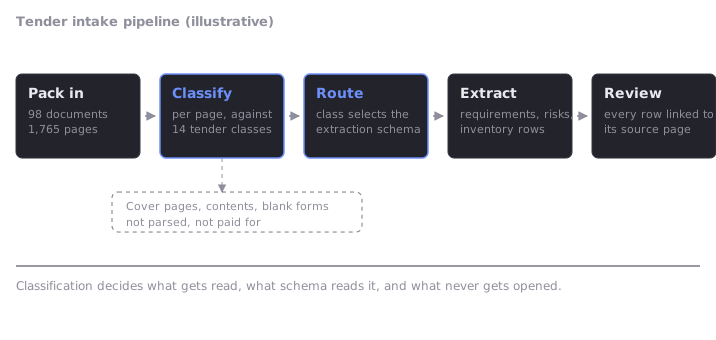
The system sorted each page into one of 14 tender document types. Each type had its own extraction rule. A service specification produced scope requirements and frequencies. Conditions of contract produced risk clauses. An inventory list produced asset rows.
This sorting addressed the compliance failure directly. Instructions to tenderers and annex forms fed the submission checklist. Evaluation criteria fed the eligibility checklist. The output was a list of annexes to complete and credentials required.
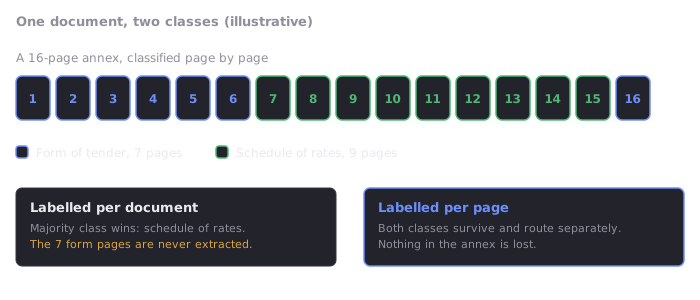
The page-level approach matters. In this pack, a 16-page annex held the form of tender on seven pages and a schedule of rates on the other nine. If the system labelled only the document, one of those parts would disappear. By sorting every page, both survived.
Sorting first also controls cost. On a 2,000-page pack, perhaps 200 pages carry content worth extracting in detail. The rest can stay searchable without being parsed into detailed fields.
Fixed fields make extracted quantities reviewable
Extraction only helps if the output can be used without re-reading the source. Two choices make the output reliable enough for bid work.
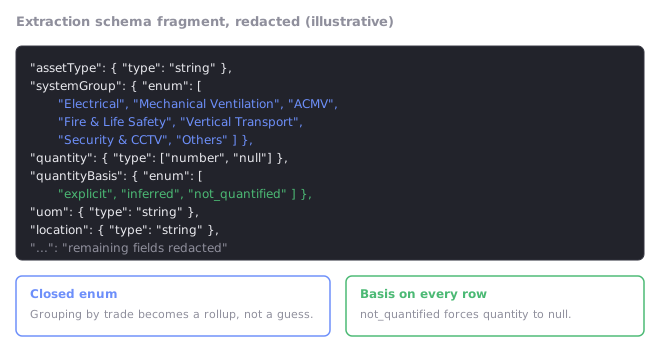
First, the trade field used a fixed list of seven values. The system could choose only from that list. That made grouping by trade repeatable, instead of depending on slightly different wording across runs.
Second, every row recorded how its quantity was obtained: explicit when the number was printed, inferred when the system counted rows, and not_quantified when neither basis existed. not_quantified forced the quantity to null. The system did not fill a gap with a plausible number, because plausible numbers create confident wrong prices.
Across the inventory workbooks, the run produced 2,612 asset rows totalling 25,273 units: 2,131 explicit, 478 inferred and 3 not quantified. No row used a value outside the fixed trade list. Of those rows, 2,509 carried a page reference and highlighted table region, so a reviewer could click a line and see the source. The 103 rows that could not be aligned were left ungrounded instead of being pointed at a row that might be wrong.
Structured pack reading gives the team more time for judgment
Document processing changes what the four-week window buys. The submission checklist comes from the pack. Each service frequency sits beside the asset it applies to. Quantities arrive grouped the way pricing needs them. Every important line traces back to its source.
The bid team still owns the judgment. It still sets the rates, risk appetite, staffing model, subcontractor choices and decision to bid. The difference is that those decisions start from a complete reading of the pack instead of a partial one.
Win rates improve when the work that decides compliance, scope and price moves into the first week. The team spends less of the cycle reconstructing the pack and more of it deciding how to win.